

Selected Lab Project — This project documents an automation philosophy applied across infrastructure and smart-home environments. Public details intentionally omit credentials, network addresses, private endpoints, and other sensitive configuration.
Overview
Automation delivers maximum value when it simplifies system operations rather than obscuring how things work.
Across my infrastructure and connected environments, automated workflows manage predictable tasks, routine health checks, state changes, telemetry notifications, failover routines, and recovery actions. The objective is never to eliminate human oversight, but to eliminate repetitive operational drag while retaining the contextual visibility and control needed to intervene when conditions deviate from baseline expectations.
Core Principle: Automate the known path, surface the exception, and preserve the manual override.
Goal / Problem
Repetitive tasks drain operational bandwidth, but blind automation trades routine friction for a worse risk: opaque systems that fail unpredictably when underlying assumptions break down.
The design mandate was to engineer automation that responds consistently to known conditions while remaining fully observable and transparent. Every automated workflow requires five immutable components: a precise trigger, clearly defined conditions, a predictable action, a safe fallback state, and an accessible mechanism for human intervention that leaves the underlying script or system intact.
Architecture
The platform operates on a unified event-driven pattern rather than treating automation as a loose collection of isolated scripts.
A trigger flags a state change, initiating automated dependency and status checks to validate whether a response is warranted. Predictable conditions run autonomously, while exceptions surface immediately for review. Comprehensive logging and telemetry record every action, and manual overrides remain permanently accessible whenever human intervention is required.
This architecture scales seamlessly across vastly different environments—from infrastructure monitoring and high-availability failover to power protection, scheduled routines, notification pipelines, and smart-home behaviors—because the core design pattern remains invariant.
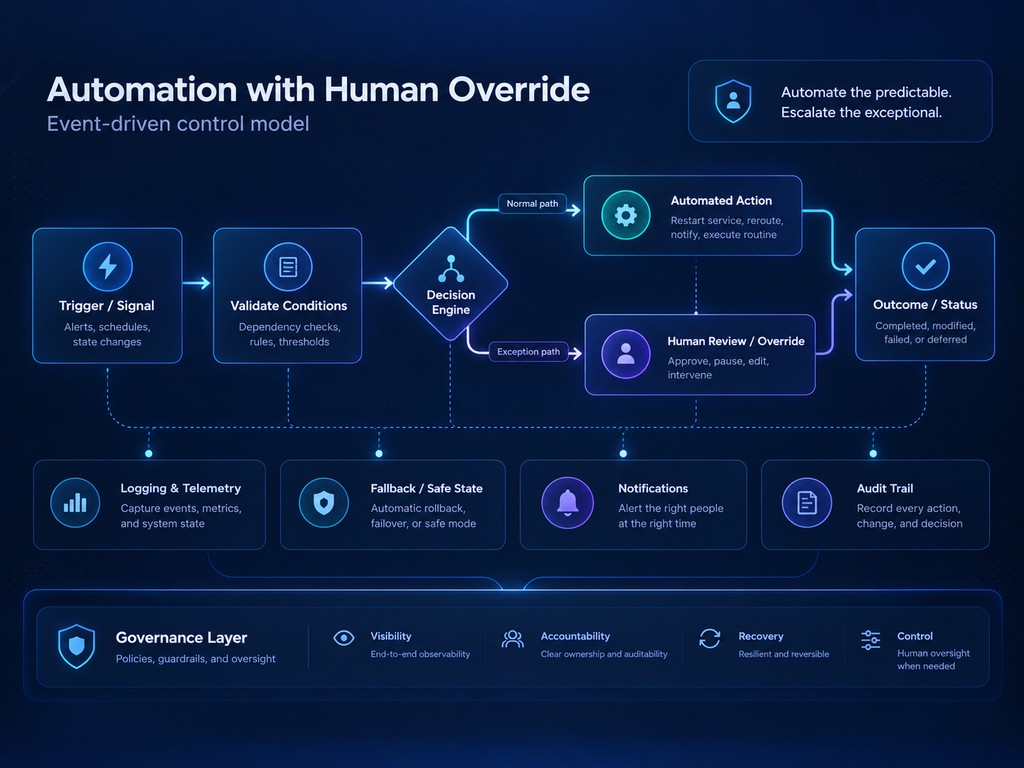
Automation flow with human override.
Technology Stack
The automation ecosystem spans infrastructure, enterprise networking, observability pipelines, smart-home environments, containerized clusters, scheduled jobs, and service-specific routines.
Real-world applications include automated alerting, recurring maintenance schedules, DNS and service failover mechanisms, dynamic endpoint routing, media workflow orchestration, and coordinated power protection. While supporting technologies vary by use case, the architecture remains anchored in system interfaces and behavior rather than vendor products: event sources, conditional rules, robust APIs, schedulers, telemetry monitors, notification channels, and accessible manual overrides.
Ultimately, the underlying tool matters far less than whether the workflow is predictable, fully observable, and recoverable.
Implementation
Automations are never deployed all at once; they roll out through a disciplined, incremental process.
I fully map the manual baseline before writing any code or logic. Next, I identify the exact trigger event, then define the minimal rule set needed to cleanly distinguish normal operating conditions from exceptions. Automate, test, and verify a single behavior before adding secondary dependencies. Logging and alerts confirm that the system acts precisely as intended, with manual controls actively maintained throughout the validation phase.
Once the routine path is proven under real-world conditions, the automation can assume broader responsibility, expanding efficiency without sacrificing system transparency.
Challenges
The greatest friction in automation occurs when real-world systems fail to conform to clean theoretical rule sets.
Devices drop offline unexpectedly, services reboot out of sequence, network conditions fluctuate, cron jobs collide with active maintenance windows, and dependencies report as technically “online” long before they are genuinely ready to service downstream traffic. Another risk is runaway automation loops, where a corrective action triggers a cascading reaction. Mitigating these realities requires built-in state awareness, sensible throttling delays, rigorous validation checks, and hard limits on automated aggression.
The ultimate engineering challenge is not simply making something happen automatically; it is making that behavior fundamentally trustworthy.
Decisions
Several core rules govern how automation is engineered and deployed across the environment:
- Scope Boundaries: Routine, deterministic tasks are automated; ambiguous conditions are intentionally left visible for human review.
- Fail-Safe Execution: Critical actions must degrade safely, ensuring workflows never rely on hidden assumptions that complicate disaster recovery.
- Native Observability: Telemetry and monitoring are embedded directly into the workflow design, ensuring every successful execution leaves a clear audit trail, and anomalies are instantly identifiable.
- Transparent Overrides: Manual intervention paths are designed to be explicit; operators must be able to bypass a workflow without needing to reverse-engineer the underlying logic first.
Lessons Learned
The most robust automation is ultimately the least noticeable.
It quietly eliminates repetitive overhead, executes consistently, and surfaces only those conditions that genuinely demand human attention. But that outward simplicity relies entirely on disciplined underlying design: explicit state tracking, well-defined boundaries, robust audit logging, and realistic expectations of failure modes.
Above all, the work reinforced that automation should never be evaluated solely by the volume of manual labor it removes. True success is measured by how much it enhances consistency, system observability, recovery speed, and operator confidence.
Guiding Axiom: Automation should reduce operational effort without reducing system understanding.
Current Status
The automation ecosystem continues to mature in lockstep with the broader infrastructure lab.
Automated workflows already govern core operational pillars—spanning proactive monitoring, routine infrastructure maintenance, service continuity, endpoint updates, media orchestration, and coordinated power protection. New smart-home and infrastructure automations are continuously evaluated against strict governance standards, prioritizing clear boundary conditions, safe fallback defaults, and absolute manual control.
Future development is intentionally strategic: the focus centers on deepening cross-system orchestration and contextual awareness rather than simply inflating the volume of automated scripts.
Gallery & Diagrams
Planned visual documentation will include sanitized automation flows, trigger-and-condition diagrams, monitoring and notification examples, failover logic, power-protection workflows, and selected smart-home control concepts.