

This case study adapts a proven process-improvement and service-level management methodology to a multi-location field-service environment.
Note: The business context is representative; proprietary systems, corporate identities, customer data, and sensitive operating metrics have been intentionally abstracted to protect confidentiality.
Executive Summary
A multi-location field-service organization relied on a time-sensitive review and close-out workflow to ensure completed work met stringent operational and quality standards. Despite an established process, performance suffered from fragmented handoffs, ambiguous ownership, incomplete documentation, and blind spots around aging inventory.
To resolve this, I designed and deployed a comprehensive process-improvement framework that explicitly defined intake channels, stage ownership, intervention thresholds, and performance monitoring. The objective was never just to chase arbitrary metrics; it was to embed a repeatable operating discipline that empowered teams to identify risk earlier and drive consistent, predictable execution.
The Challenge
The service-level target appeared straightforward on paper: complete every review within the mandated timeframe. In practice, performance relied on a fragile chain of interconnected dependencies.
Work frequently stalled because of missing documentation, ambiguous team handoffs, late-stage exception discovery, and a lack of early-warning visibility for items approaching SLA thresholds. Because these friction points were managed reactively, leadership and teams spent excessive effort firefighting overdue work rather than preventing backlogs.
The core challenge was diagnosing systemic process breakdowns and engineering lightweight controls that elevated performance without increasing administrative overhead.
Context
The enterprise managed a high-volume customer service environment where repeat interactions directly impacted operational performance. To manage this volume, the organization operated across multiple locations, with distributed teams handling field execution, documentation, quality reviews, and record closeout through a shared workflow.
Regional variance in workload volume, staffing levels, local habits, tenure, and exception types resulted in highly inconsistent execution across sites. Leadership required an operating model that preserved localized flexibility while establishing rigorous, standardized expectations for ownership, timing, escalation pathways, and accountability.
Consequently, the analysis evaluated the end-to-end workflow rather than individual employees or locations in isolation.
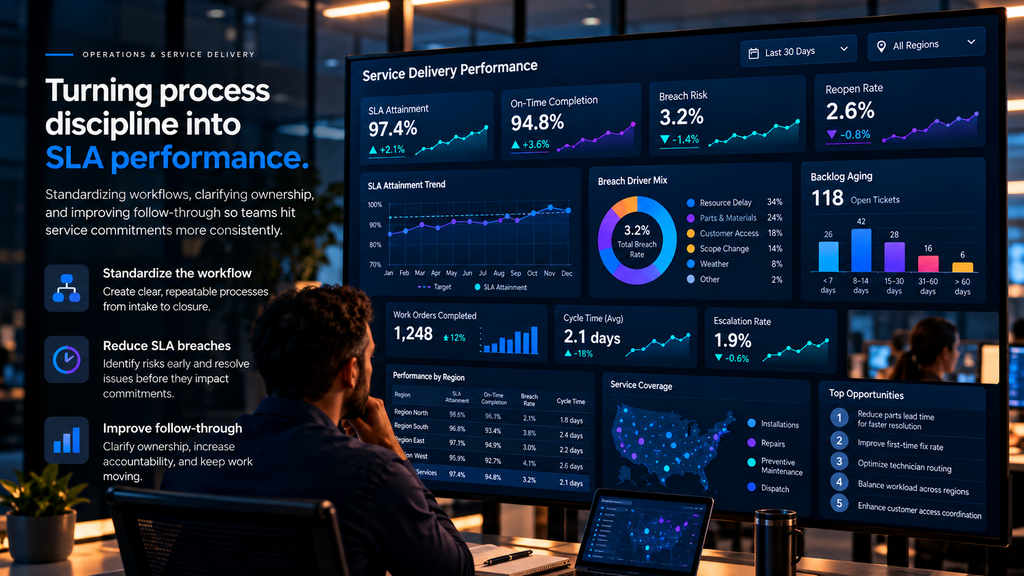
Dashboard concept. Business units, metrics, and data are simulated for portfolio presentation.
What the Data Showed
Telemetry and process mapping showed that workflow friction clustered around predictable systemic bottlenecks.
Latency spikes mapped directly to transition failures: unvalidated data at intake, diffuse ownership boundaries during handoffs, delayed exception tagging, and a lack of real-time age stratification in active queues. Critically, standard dashboards flagged items only after remediation was mathematically infeasible. This exposed a core structural flaw: treating SLAs as real-time controls rather than lagging symptoms. True operational control required monitoring leading indicators—queue aging, input completeness, unassigned exceptions, and handoff velocity.
This diagnostic breakthrough redirected enterprise focus from post-mortem root-cause analysis to predictive risk mitigation, identifying vulnerabilities before service levels were breached.
Approach
The improvement initiative began with end-to-end process mapping, establishing precise requirements for successful execution from initial intake through final closeout.
The resulting governance framework focused on five core pillars:
- Definition: Standardized process entry points, exit criteria, and SLA tracking clocks.
- Ownership: Assigned unambiguous accountability for every lifecycle stage and handoff.
- Standard Work: Defined mandatory inputs, review protocols, and structured exception handling.
- Visibility: Implemented tracking for queue age and leading indicators to surface risk before deadlines lapsed.
- Governance: Instituted a regular review cadence for performance tracking, operational escalations, and recurring root-cause resolution.
The overarching objective was to strengthen structural process reliability rather than relying on individual heroics to rescue overdue work.
Solution
The deployed operating model integrated standardized workflow controls with transparent management visibility.
Strict intake criteria governed incoming work, which progressed through explicit ownership stages and was tracked against active aging thresholds. Dedicated exception pathways diverted non-standard items into specialized review streams, preventing them from clogging the primary queue indefinitely.
At the same time, I redesigned performance reporting around operational action. Rather than displaying post-mortem SLA compliance, dashboards equipped leaders to identify work approaching risk, pinpoint accumulation bottlenecks, and direct coaching or process remediation precisely where failures occurred. This established a fully closed loop uniting execution, measurement, intervention, and continuous improvement.
Implementation
The rollout was intentionally structured in phases to ensure adoption and sustainability:
- Baseline & Alignment: The initial phase established a reliable operational baseline by mapping existing workflows, isolating recurring failure points, and achieving cross-functional consensus on the core SLA definition.
- Standardization & Training: Next, I deployed standardized process rules, ownership structures, escalation thresholds, and management cadences. Teams were trained on both the mechanics and the operational rationale, framing the model as an enablement tool rather than a compliance mandate.
- Active Governance & Evolution: Performance reviews transitioned from retrospective scorecards to active queue management. The team addressed emerging risks while recovery was still viable, and recurring bottlenecks fed directly into coaching, documentation updates, and process refinement.
The model continuously evolved as operational telemetry uncovered new optimization opportunities.
Results
The redesigned process transformed service-level management from a reactive exercise into a structured, proactive discipline.
Distributed teams secured clear ownership of their workflows, leadership gained early-warning visibility into emerging operational risk, and systemic process failures were decoupled from isolated, one-off exceptions. The framework broke the cycle of emergency escalations, establishing a repeatable operating rhythm to identify bottlenecks, assign accountability, and drive continuous improvement to completion.
Most importantly, SLA performance evolved from a lagging scoreboard into a predictable metric that the organization could manage and protect proactively.
Lessons Learned
Service-level performance is rarely improved by obsessing over the final percentage alone.
The ultimate outcome depends entirely on everything upstream: process clarity, input hygiene, ownership models, handoff velocity, early visibility, escalation paths, team enablement, and management discipline. This initiative reinforced core operating principles that translate universally across industries:
- Make ownership explicit at every transition point.
- Measure the leading conditions that drive the outcome, not just the lagging metric.
- Surface operational risk well before deadlines lapse.
- Standardize what requires consistency while preserving human judgment where it adds strategic value.
Ultimately, process improvement only becomes sustainable when the operational ecosystem makes the desired behavior the path of least resistance.